
How Interest Rates Affect Mutual Funds: What Every Investor Should Know


Interest rates are one of the most influential factors affecting financial markets. Whether you're investing in equity mutual funds, debt mutual funds, or hybrid funds, changes in interest rates can significantly impact your portfolio's performance.
Many investors focus only on stock market movements while overlooking the role played by interest rates. Understanding this relationship can help you make smarter investment decisions and reduce unnecessary risks.
What Are Interest Rates?
Interest rates represent the cost of borrowing money and the return earned on savings. In India, the Reserve Bank of India (RBI) adjusts the Repo Rate, which influences lending and borrowing rates across the economy.
When RBI Raises Interest Rates
Borrowing becomes more expensive
Home loan EMIs increase
Business expansion slows
Consumer spending reduces
Inflation generally moderates
When RBI Cuts Interest Rates
Loans become cheaper
Businesses invest more
Consumer spending increases
Economic growth accelerates
Financial markets often receive positive sentiment
How Interest Rates Affect Debt Mutual Funds

Debt mutual funds invest primarily in:
Government Securities (G-Secs)
Corporate Bonds
Treasury Bills
Commercial Papers
Money Market Instruments
The relationship between interest rates and bond prices is inverse.
Interest Rates | Bond Prices | Debt Fund Impact |
Increase | Fall | NAV Declines |
Decrease | Rise | NAV Improves |
Example
Suppose a debt fund holds bonds paying 7% annual interest.
If new bonds are issued at 8%, investors prefer the newer bonds, making the older 7% bonds less valuable. Consequently, the NAV of the debt mutual fund declines.
Similarly, if interest rates fall to 6%, the existing 7% bonds become more attractive, increasing their market value and boosting the fund's NAV.
Which Debt Funds Are Most Sensitive?
Fund Type | Interest Rate Sensitivity |
Overnight Funds | Very Low |
Liquid Funds | Low |
Ultra Short Duration Funds | Low |
Short Duration Funds | Moderate |
Corporate Bond Funds | Moderate |
Gilt Funds | High |
Long Duration Funds | Very High |
Rule: The longer the maturity (duration), the greater the impact from interest rate changes.
Impact on Equity Mutual Funds
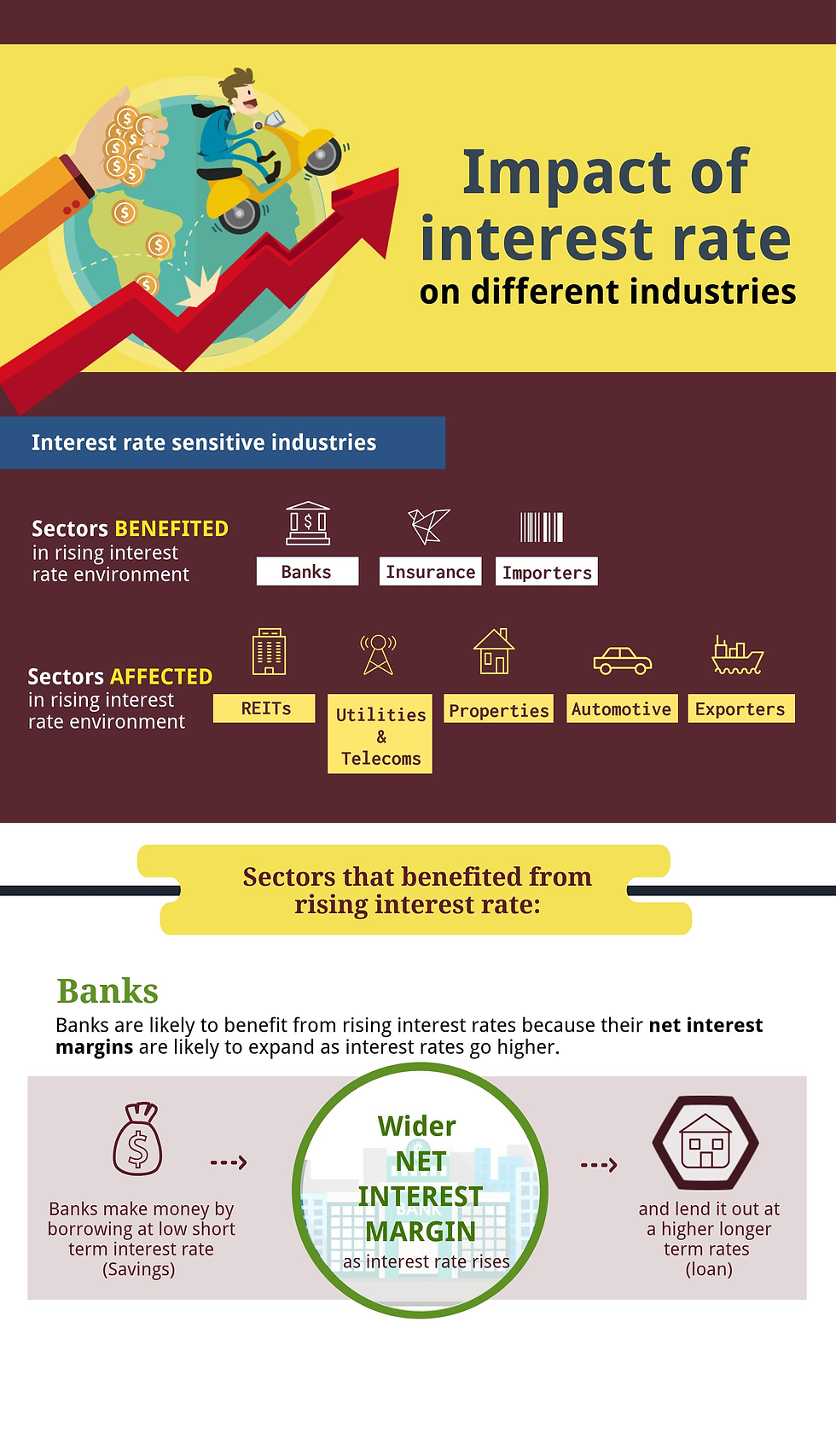
Although equity mutual funds don't invest in bonds, interest rates influence company earnings, investor sentiment, and market valuations.
When Interest Rates Rise
Higher interest rates generally lead to:
Higher borrowing costs
Reduced corporate profits
Lower consumer spending
Slower economic growth
Increased market volatility
Sectors that may be negatively affected include:
Real Estate
Automobiles
Banking (mixed impact)
Infrastructure
Capital Goods
When Interest Rates Fall
Lower interest rates often support:
Business expansion
Increased consumer demand
Higher corporate earnings
Improved stock valuations
Positive market sentiment
Growth-oriented sectors like technology, consumer discretionary, and manufacturing may benefit during these periods.
Impact on Hybrid Mutual Funds
Hybrid funds invest in both equities and debt securities.
heir performance depends on:
Stock market movements
Bond price movements
Asset allocation strategy
During rising interest rates:
Debt allocation may experience pressure.
Equity allocation may become volatile.
During falling rates:
Both debt and equity portions may benefit, depending on market conditions.
SIP Investors: Should You Worry?
One of the biggest misconceptions is that investors should stop SIPs when interest rates rise.
In reality:
Rising interest rates can create attractive investment opportunities.
Market corrections allow SIPs to accumulate more units.
Over the long term, disciplined SIP investing benefits from market fluctuations through rupee cost averaging.
For long-term investors, maintaining consistent SIPs is often more effective than trying to time interest rate cycles.
How Different Mutual Funds React
Mutual Fund Category | Rising Rates | Falling Rates |
Liquid Funds | Minimal Impact | Minimal Impact |
Short Duration Debt Funds | Slightly Negative | Slightly Positive |
Long Duration Debt Funds | Negative | Strong Positive |
Equity Funds | Short-term Pressure | Generally Positive |
Hybrid Funds | Mixed | Generally Positive |
Investment Strategies During Different Interest Rate Cycles
When Rates Are Rising
Prefer shorter-duration debt funds.
Continue SIPs in equity funds.
Diversify across asset classes.
Avoid making decisions based on short-term market movements.
When Rates Are Falling
Long-duration debt funds may benefit.
Equity markets may gain from improved economic conditions.
Review asset allocation to align with financial goals and risk tolerance.
Common Investor Mistakes Redeeming investments due to temporary NAV declines.
Assuming all mutual funds react the same way to interest rates.
Ignoring portfolio diversification.
Attempting to time the market based solely on interest rate announcements.
Focusing only on short-term returns instead of long-term objectives.
Key Takeaways
✔Interest rates have a direct impact on debt mutual funds through bond prices.
✔ Equity mutual funds are influenced indirectly via economic growth and corporate earnings.
✔ Long-duration debt funds are more sensitive to interest rate changes than short-duration funds.
✔ Hybrid funds experience a combination of equity and debt market effects.
✔ Long-term investors should focus on disciplined investing and diversification rather than reacting to short-term interest rate movements.
Conclusion
Interest rate movements are a normal part of every economic cycle. Rather than fearing rate changes, investors who understand their impact can position their portfolios more effectively.
A well-diversified portfolio aligned with your financial goals and investment horizon is generally better equipped to navigate changing interest rate environments than one built around short-term market predictions.


Comments